All-time Low Line: Expertise + Depiction= Optimum Recovery

California's workers' settlement system supplies comprehensive advantages, however just for workers that comprehend exactly how to browse it efficiently. The 2025-2026 legal modifications create extraordinary opportunities for damaged workers, yet these benefits only profit those who recognize exactly how to use them. The statistics do not exist: Represented employees constantly attain much better end results, faster resolutions, and higher negotiations. They prevent the terrible errors that can completely harm their cases and their futures. ** Don't become an additional fact of workers that opted for less than they was worthy of. The insurance policy business have groups of attorneys and insurers working to minimize your insurance claim. Shouldn't you have a seasoned supporter fighting for your maximum healing? Contact today. Your future-- and your family's economic protection-- might depend on the decisions you square away currently.
The 30-Day Policy That Ruins A Lot More Claims Than Any Kind Of Other Factor
Here's the harsh truth: Miss the 30-day injury reporting deadline, and your case is dead. Period. No exemptions, no allures, no 2nd chances. The 30-day injury reporting deadline is absolute and can not be forgoed.
I've seen construction workers shed $150,000+ in benefits due to the fact that they assumed their supervisor reporting the injury sufficed. It's not. You must personally inform your company in creating within 1 month. For recurring stress injuries or work diseases, the clock begins when you understood or must have recognized the condition was job-related.
Pro idea from the trenches: Email your supervisor and HR department promptly, making use of language like "I am formally notifying you of a work-related injury that occurred on [date]." Keep the read receipt. This straightforward e-mail has actually saved clients 10s of thousands when employers later asserted they were never informed.
One customer, a nurse in San Diego, created repetitive strain injury over months of repeated charting. She stated wrist pain to her supervisor but didn't officially report it as occupational till 3 months later on. The insurance provider attempted to refute her insurance claim based upon late coverage, however we proved the supervisor's expertise comprised useful notice, protecting a $28,000 negotiation.
Why Insurer Auto-Deny 33% of Legitimate Claims (And Exactly How to Fight Back)
Allow me share something insurance provider do not want you to recognize: First claim rejections impact approximately 33% of workers' compensation cases, and numerous of these are automatic rejections created to inhibit workers from going after legit benefits.
The approach is simple: reject first, examine later. Insurance provider recognize that many workers will not appeal effectively or will approve lowball negotiations rather than battle. What they're not relying on is employees who comprehend the system and have proper depiction.
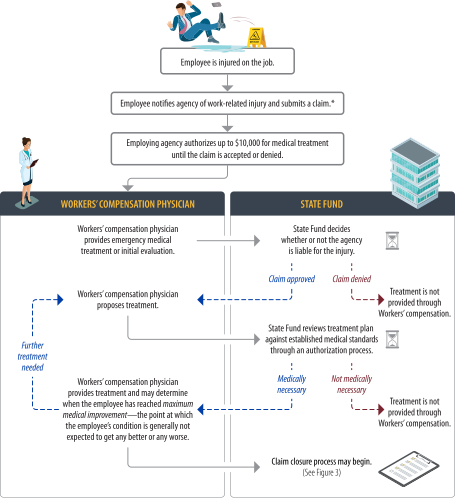
Insurance provider have 90 days to accept or deny claims, but have to provide standing letters within 14 days. During this period, they need to authorize approximately $10,000 in clinical therapy. I have actually seen business try to avoid this by slow-walking the process-- do not allow them.
Real instance instance: A vehicle chauffeur in Fresno harmed his back lifting freight. The insurer refuted his claim, mentioning "insufficient clinical evidence of work-relatedness." We obtained the security video footage from his employer revealing the exact minute of injury, the emergency clinic documents showing instant coverage of job injury, and declarations from colleagues who witnessed the incident. The denial was rescinded, and he got $52,000 in complete benefits.
The essential understanding: Most denials are based on trivialities or not enough preliminary paperwork, not the actual values of your case. With proper legal representation, success prices jump from 30% for unrepresented workers to 70-90% with lawyer help.
What the 2025 Changes Mean for Your Instance Now
The landscape has shifted substantially for damaged workers, yet you require to act strategically to benefit. Assembly Bill 2337 modernized the allures procedure by licensing digital signatures on all Employees' Compensation Appeals Board documents, making it simpler to submit appeals and keep momentum in your situation.
The useful advantages:
- Faster file processing means quicker resolutions
- Digital filing minimizes governmental hold-ups that insurance provider utilized to make use of
- Video hearings (starting March 2025) get rid of traveling barriers for workers statewide
- Enhanced oversight indicates insurer face higher analysis for claim hold-ups
Existing chance home window: Insurer are still adapting to the new demands. This transitional period creates possibilities for employees that understand the modifications and have advocates who can utilize them efficiently.
The The Golden State Workers' Payment Overview Every Injured Employee Demands (2025-2026)
California's employees' payment system refined 363,900 office injuries in 2023 with $16.7 billion in overall losses, making it one of the country's most extensive employee security systems. The 2025-2026 legal modifications have essentially shifted the playing area in favor of injured employees-- however only if you know just how to use them to your benefit.
What I'm sharing right here isn't theoretical advice from a book. These are battle-tested methods from real instances, including the typical mistakes that set you back employees thousands and the insider understanding that divides successful claims from refuted ones.
When You Absolutely Required an Attorney (Based Upon Genuine Case End Results)
The information is clear: Success prices enhance considerably with correct lawful representation, increasing from around 30% for unrepresented workers to 70-90% with attorney help. (being struck by objects at work)
You require immediate lawful appointment if:
- Your insurance claim is denied (even partially)
- Your employer strikes back versus you
- You're pushed to go back to work prior to clinical clearance
- The insurer quits paying advantages without description
- You're offered a negotiation (never ever approve without testimonial)
- You create difficulties or new symptoms
- Your injury impacts your capability to do your routine task
The fee structure shields you: California's contingency cost system needs attorney charges between 9-15% of advantages awarded, with all costs based on Employees' Compensation Judge authorization. You pay absolutely nothing upfront, and charges only come from what we recover for you.
Genuine impact of depiction: A health center worker in Bakersfield wounded her shoulder in a person training incident. She at first attempted to manage the claim herself and was provided $4,000. After hiring our firm, we uncovered extra injuries through proper clinical examination, recorded continuous work restrictions, and bargained a $38,000 negotiation. Our cost was $5,700-- she netted $32,300 versus the $4,000 she would have received alone.
The Negotiation Figures They Do Not Want You to See
Allow's speak money-- since that's what this is actually about. Average settlement amounts in The golden state array from $2,000 to $40,000, with many workers obtaining in between $2,000 and $20,000. Yet here's what those statistics do not tell you: the distinction in between the low end and high end frequently boils down to depiction and technique.
Genuine negotiations from my technique:
- Head injury cases: Ordinary $93,942
- Several body component injuries: Typical $62,859
- Amputations: Average $126,000
- Back injuries with correct documentation: $25,000-$ 75,000
- Recurring stress and anxiety injuries: $15,000-$ 45,000
The surprise multiplier result: Several employees don't recognize that their workers' payment insurance claim might also set off third-party liability insurance claims. A contractor who fell because of a defective safety belt got $35,000 in workers' comp advantages however an added $280,000 from the equipment producer. This is why early lawful appointment is critical-- we can recognize all possible resources of recovery.
One of my customers, a shipment vehicle driver, was rear-ended while making a delivery. His employees' comp situation went for $28,000, yet the third-party auto claim versus the other chauffeur chose an added $150,000. Without understanding both systems, he would have missed out on $150,000 in healing.
Why Is the Strategic Option for The Golden State Employees
After 15 years in this field, I have actually seen just how the ideal lawful group changes results. The workers who attain the very best outcomes don't simply need any type of lawyer-- they require advocates who understand The golden state's intricate workers' payment system in and out, that stay existing with legal modifications, and that have the sources to eliminate major insurance policy firms.
integrates deep lawful knowledge with authentic advocacy for injured workers. We understand that your workers' payment insurance claim isn't almost cash-- it's concerning your capacity to support your family members, preserve your dignity, and safe and secure appropriate medical treatment for injuries that might influence you for life.
Our strategy is various: We don't just process documentation. We investigate every angle, create detailed medical proof, determine all possible sources of recovery, and fight aggressively for maximum payment. work comp evaluation. When insurance provider see representing a claim, they recognize they're dealing with experienced advocates who won't approve unreasonable settlements
The appointment is complimentary, and you pay nothing unless we win. Offered the complexity of California's workers' settlement system and the significant money at stake, getting specialist assistance isn't simply smart-- it's vital for safeguarding your civil liberties and maximizing your recuperation.
Your following action: Do not allow insurance policy business capitalize on your unfamiliarity with the system. Get in touch with today for a complimentary consultation. We'll evaluate your instance, discuss your rights under the brand-new 2025 regulations, and detail an approach to achieve the most effective feasible outcome for your situation.
Keep in mind: The very same injury can cause a $5,000 negotiation or a $50,000 settlement depending upon how it's managed. Make certain you're on the best side of that equation.
The Allure Refine: Your Second Possibility at Justice
Below's something that may surprise you: Employees have 20 days to submit Request for Reconsideration after damaging choices, yet many workers do not also understand this alternative exists. The insurance provider are counting on your ignorance.
The WCAB process actually prefers ready workers. The Workers' Settlement Appeals Board (WCAB) functions as the judicial arm of the system, comprising seven members selected by the Guv. These judges see the same insurer techniques daily, and they're not easily misleaded.
Strategy that works: I lately represented a mechanic whose claim was originally refuted for "pre-existing problems." We collected 10 years of clinical records revealing no prior back issues, acquired witness statements from colleagues, and provided biomechanical evidence describing how the specific lifting occurrence caused his injury. The Employees' Settlement Court not only approved his claim however awarded maximum long-term impairment advantages totaling $67,000.
The compulsory settlement seminar is your settlement benefit. Prior to any type of trial, both sides need to attend a negotiation conference where a judge facilitates arrangements. Insurer understand that if they don't settle fairly, they risk a trial where a damaged worker with strong proof usually wins big.
Common Mistakes That Expense Employees Thousands
After seeing numerous instances, specific mistakes show up over and over again:
Blunder # 1: Accepting the very first settlement offer. Insurance firms generally supply 30-50% of an insurance claim's real value. I've never ever seen a first offer that was fair. A painter in San Jose was provided $8,000 for a shoulder injury. After correct instance growth, we went for $41,000.
Mistake # 2: Not reporting all signs right away. Your first clinical record ends up being the foundation of your whole case. If you point out only back pain but later establish leg numbness, the insurance provider will claim it's unassociated. Always give your physician a full image of exactly how you feel, also if symptoms appear minor.
Blunder # 3: Returning to function also early. I comprehend the monetary pressure, but returning prior to you're medically removed can completely damage your case. Once you return, insurance coverage business argue you're not handicapped. A building and construction worker in Waterfront returned after 2 weeks with a back injury, then re-injured himself. The insurance policy company rejected benefits for the 2nd injury, costing him $35,000.
Mistake # 4: Not comprehending permanent impairment rankings. The golden state's complex disability rating system considers clinical problems, profession, and age factors. A 10% handicap ranking might sound low, but also for a 50-year-old construction worker, it can mean $25,000+ in advantages. Several workers accept negotiations without recognizing what their special needs score need to be.
Why 2025 Is the most effective Year Yet for The Golden State Workers' Payment Claims
The game transformed totally on January 1, 2025, and many workers do not even know it. Assembly Costs 1870 currently calls for all The golden state companies to alert workers of their right to attorney consultation-- something insurance provider fought with every available resource to stop.
Here's what this implies for you: Every workplace must currently display updated DWC Type 7 posters explicitly specifying that you deserve to speak with a qualified lawyer which lawyer fees are generally paid from your healing, not out of your pocket. This isn't simply documentation-- it's a fundamental change that levels the playing area.
I lately had a client in Los Angeles that was informed by her employer that hiring a lawyer would "make complex points" and delay her advantages. Under the brand-new regulation, that employer was lawfully called for to notify her of her attorney rights. When we used this offense as leverage, her instance cleared up for $34,000 rather than the initial $8,000 offer.
The numbers speak for themselves: Short-lived special needs benefits raised 3.8% for 2025, with optimal weekly repayments rising from $1,619.15 to $1,680.29. For an employee making $80,000 annually who's off benefit 6 months, this increase alone includes over $900 to their complete healing.
The Medical Carrier Network Catch (And Just How to Escape It)
Here's where most workers obtain trapped: Your employer likely has a Medical Carrier Network (MPN) of medical professionals who are essentially paid to minimize your case. Employees have substantial civil liberties in doctor choice with predesignation and Medical Company Network options, but many do not understand how to work out these rights.
The predesignation method: Predesignation permits employees to choose their personal physician for job injuries if they complete DWC Kind 9783 before injury occurs. I advise all my customers complete this kind when beginning new work. It's like insurance for your employees' settlement insurance claim.
Current success: A storage facility employee in Oakland had predesignated her family practitioner that had actually treated her for several years. When she injured her shoulder, the employer tried to force her into their MPN. We implemented her predesignation civil liberties, and her relied on medical professional correctly recorded the level of her injuries, resulting in a $43,000 settlement versus the $5,000 the MPN physician suggested.
Also without predesignation, you have rights. You can ask for a consultation within the MPN if you're unsatisfied with treatment, and you deserve to an Independent Medical Evaluation (IMR) if treatments are denied. Independent Medical Evaluation (IMR) provides final allure civil liberties for denied clinical therapy, and it's totally totally free to workers.